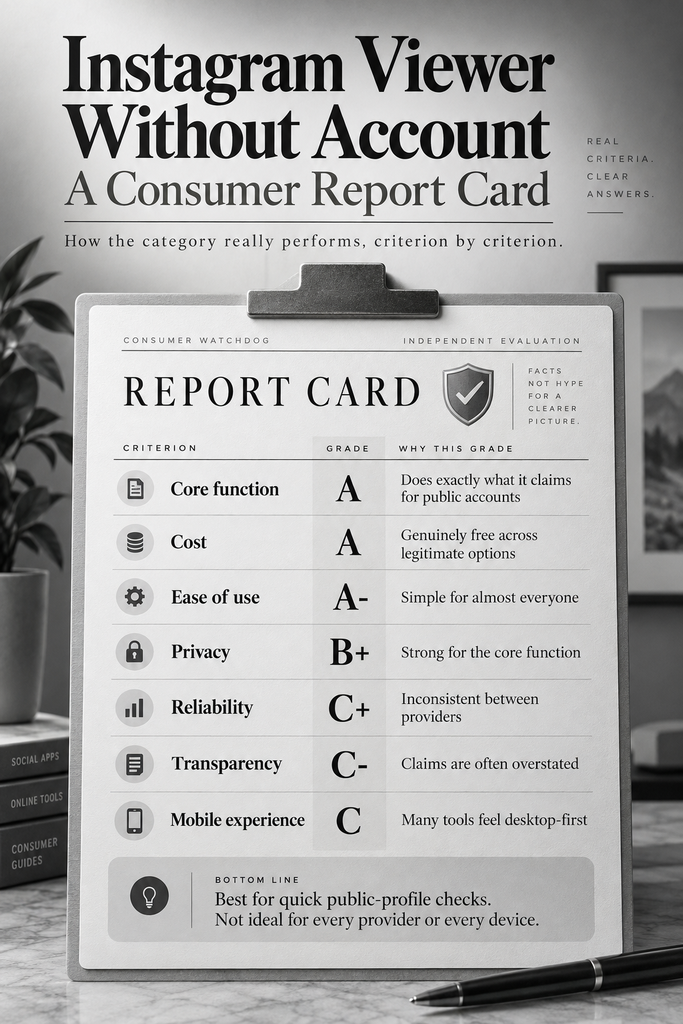
Rather than reviewing one specific tool, this guide grades the entire instagram viewer without account category, criterion by criterion, the way a consumer watchdog would. Here’s how it actually holds up when you break it down.
The Report Card
| Criterion | Grade | Why |
| Core function | A | Does exactly what it claims for public accounts, consistently |
| Cost | A | Genuinely free across legitimate options |
| Ease of use | A- | Simple for almost everyone, minor friction on some sites |
| Privacy | B+ | Strong for the core function, weaker on data practices disclosure |
| Reliability | C+ | Wildly inconsistent between individual providers |
| Transparency | C- | Marketing often overstates what’s technically possible |
| Mobile experience | C | Many tools clearly built desktop-first |
Core Function: A
Judged purely on whether it does what the name promises, an instagram viewer without account earns top marks here. Public profile browsing, no login required, works reliably across every legitimate option tested. This is the one criterion where the category consistently delivers exactly what it advertises.
Cost: A
Free, across the board, for the core function. No consumer should need to pay for basic public-profile browsing, and the legitimate portion of this category respects that. Any option asking for payment to unlock the basic function is working outside the norm and deserves extra scrutiny. Paid tiers do exist in this space, but they typically add bulk features or extended history rather than gatekeeping the fundamental function, and that distinction is worth checking before paying for anything at all.
Ease of Use: A-
Most options require nothing beyond typing a username, which is about as low-friction as a digital tool gets. The minus reflects genuine variation, some sites bury the actual search function under ads or confusing navigation, which shouldn’t happen for something this fundamentally simple. A username field should be the very first thing a visitor sees, not something buried three scrolls down past promotional banners, and the sites that get this basic layout right deserve real credit for it.
Privacy: B+
For the specific function of anonymous, logged-out browsing, this category delivers well. No session gets tied to your identity, and the account you’re viewing has no way to see who looked. The grade isn’t higher because data handling by the tools themselves, what they collect about your visit, varies and is often poorly disclosed, which matters for anyone using a specific tool regularly rather than once. A single occasional visit carries minimal practical risk on this front. A daily habit built around one specific, poorly disclosed tool carries meaningfully more, which is exactly the kind of nuance a flat pass or fail grade would miss entirely.
Reliability: C+
This is where the category shows real weakness. Quality swings dramatically between individual providers. A tool that works flawlessly today might be redesigned, monetized more aggressively, or simply gone within months. That volatility isn’t unique to this specific space, plenty of small, ad-supported web tools follow the same lifecycle, but it’s worth naming explicitly here since it directly affects anyone planning to rely on a specific option long-term. Consumers shouldn’t expect the consistency they’d get from an established, stable service, and building a habit around any single specific tool carries real risk of that tool changing or disappearing.
Transparency: C-
The weakest grade in this report card, and worth taking seriously. A meaningful share of options in this category market themselves using language that implies broader capability than actually exists, private account access, visitor tracking, features that simply aren’t technically real. This isn’t a subtle marketing exaggeration either, it’s a factual misrepresentation of what’s technically possible, and it’s common enough across the category to bring down the grade meaningfully. A consumer relying on marketing copy alone, rather than testing actual behavior, is likely to end up misinformed about what they’re actually using.
Mobile Experience: C
Plenty of tools in this category were clearly designed for desktop first, with mobile support added afterward rather than built in from the start. Layout issues, heavier ad load, and occasional broken functionality show up more often on mobile than desktop, which matters given how much browsing happens on phones now. A category this focused on quick, casual lookups should logically prioritize mobile first, given how often that’s exactly where the need arises, and the fact that it often doesn’t is a real, ongoing gap.
Before You Choose One
Given these grades, a few practical habits go a long way for anyone actually choosing an instagram viewer without account. Test any specific instagram viewer without account option on a profile you already know before relying on it for something that matters. Watch for what it asks of you, a username should be the entire requirement, and treat any request beyond that as a serious red flag rather than a minor inconvenience.
Don’t assume consistency across the category based on one good or bad experience. The C+ reliability grade exists precisely because individual results vary so much, and judging the whole space off a single data point misrepresents how uneven it actually is. A single great experience doesn’t guarantee the next tool you try will match it. A single bad one doesn’t mean the entire category is worthless either. Both reactions overcorrect based on a sample size of one.
Red Flags That Lower an Individual Tool’s Grade
Beyond the category-wide grades above for any instagram viewer without account, specific tools can score meaningfully worse on an individual basis. A request for your Instagram password drops any tool’s grade to failing, immediately, regardless of anything else it does well. A claim of private account access does the same. Excessive, intrusive advertising pulls down the ease-of-use and mobile-experience grades specifically, even when the core function still technically works.
Conversely, a tool that sticks to its honest, narrow scope, asks only for a username, discloses its data practices clearly, and performs consistently across devices, earns grades meaningfully better than this report card’s category-wide averages suggest. The grades here describe the category broadly. Individual tools can and do land well above or below this baseline. Finding one of those better-than-average options is really the whole practical goal of everything covered in this guide, since the category-wide grades exist to help you recognize the difference, not to discourage you from looking for it.
The Consumer Verdict
As a category, an instagram viewer without account earns a solid, if uneven, overall grade, which is more nuanced than either a glowing endorsement or a dismissal would suggest. The core promise, free, easy access to public content without an account, holds up reliably. What drags the average down is inconsistency between providers and a transparency problem that shows up more often than it should across marketing claims in this space.
For a consumer weighing whether to actually use an instagram viewer without account, that translates into a simple practical takeaway: the category is worth using, but not worth trusting blindly. Test before relying, watch for the specific red flags outlined here, and treat any tool’s own marketing claims as a starting point for verification rather than a guarantee. Approached that way, this category delivers genuine value. Approached uncritically, it’s exactly where the C-minus transparency grade tends to catch people off guard.